
Years ago, a parent named Sam emailed to ask if coconut is a tree nut, and if coconut non-dairy foods should be avoided with a tree nut allergic child.
We recently found out our son has multiple food allergies, including tree nuts and dairy. A lot of the coconut products say “contains tree nuts.” Are these products safe for our son, or should we avoid them?
I shared a complete response at the time. But today I’m updating this post with even more helpful information that’s easier to follow.
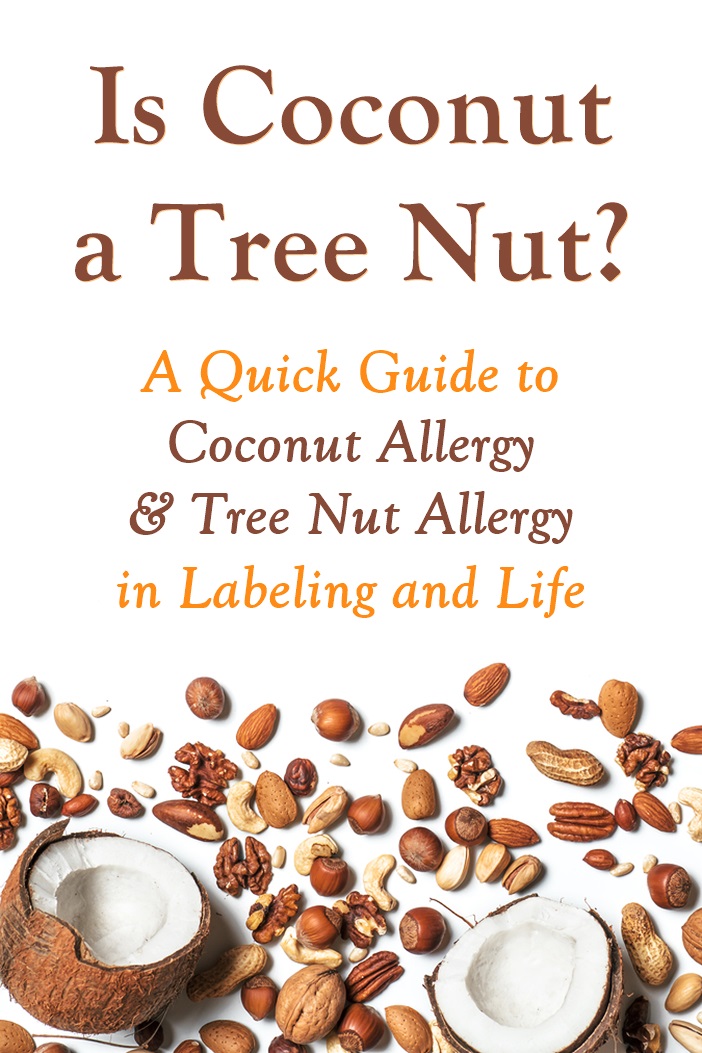
Is Coconut a Tree Nut?
I’ve received many comments on recipes labeled as “nut-free” that contain coconut. It’s not a mistake. Botanically speaking, the coconut is a drupe (fruit), not a nut. Coconut can be a confusing food because it contains the word “nut” in its name. But a coconut is not a true tree nut and doesn’t contain nut proteins.
This information has been confirmed by two leading organizations, Food Allergy Research & Education (FARE) and the American College of Allergy, Asthma & Immunology.
But Cashews Aren’t True Nuts Either, Are They?
Botanically speaking, most “nuts” are actually seeds. Almonds, pecans, walnuts, cashews, pecans, and others are the seeds of drupe fruits. But we’ve come to know them as culinary nuts. In cuisine, we think of nuts as any large, oily, edible kernels found within a shell. And when we read about top allergen studies, they are typically referring to these “culinary nuts” as tree nuts.
Scientists in the U.S. have found that nine nuts account for the majority of tree nut allergies. They include almonds, Brazil nuts, cashews, hazelnuts, macadamias, pecans, pine nuts, pistachios, and walnuts.
Can Someone With a Tree Nut Allergy Eat Coconut?
I can’t advise whether or not coconut is safe for an individual. Anyone can be allergic to any food protein. But research has shown no correlation between common tree nut allergies and coconut allergy.
In 2010, a study was published in the Journal of Pediatric Allergy and Immunology to characterize the relationship between sesame, coconut, and nut allergies in children. Researchers from the Children’s Hospital of Boston found that children with histories of both peanut and tree nut reaction were more likely to have a history of sesame reaction. But children with a sensitization or allergy to peanuts or tree nuts were not more likely to be sensitive or allergic to coconut.
In other words, the odds that a child with a tree nut allergy also has a coconut allergy are no greater than the odds that a child without a tree nut allergy has a coconut allergy. In fact, many children with tree nut allergies are able to consume coconut-based dairy alternatives without a problem.
This is why it’s essential to test for coconut allergy specifically. Coconut allergy is considered rare, but it is still very possible to be allergic to coconut. And I have heard some physicians state that they’ve seen a rise in coconut allergies, possibly due to the dramatic increase in coconut products.
Check with your physician to find out if coconut is an issue for you. Coconut is on many food allergy test panels, and can be tested for individually.
Why Do Products with Coconut State “Contains Tree Nuts?”
So why does the FDA require coconut to be labeled as a tree nut? No one really knows for sure.
When the FDA passed the Food Allergen Labeling and Consumer Protection Act (FALCPA) several years ago, they included coconut on their list of tree nuts. Therefore all products with coconut must make it recognizable or specifically note that tree nuts are found in the product.
Many researchers, organizations, and food manufacturers have contested labeling coconut as a tree nut for years. But it’s very hard to get the wording of a law changed.
The EU does a little bit better job with tree nut allergy labeling. Food manufacturers can’t just list “tree nut allergy.” They have to call out which tree nut(s) specifically. And their list of tree nuts includes almonds, Brazil nuts, cashews, hazelnuts, macadamias, pecans, pistachios, and walnuts. They specifically state “Other types of nuts, and other foods which are not nuts (even though they are called nuts i.e. chestnuts, pine nuts and coconut), are not named in the rules.”
What If I Am Dealing With a Coconut Allergy?
The FDA might currently require the disclosure of coconut, but it’s important to still keep your guard up. Since coconut isn’t actually a tree nut, and it hasn’t been shown in studies to be a true top allergen, it might not be called out in recipes, by restaurants, or in other settings.
But I have created this Coconut Substitution Guide to help you replace coconut in most recipes!

10 Comments
Very Informative article thankyou for sharing
Pingback: Inside Out Everything Grilled Cheese Bagel Recipe to Celebrate the 10 New Dairy-Free Products from Daiya
Pingback: Fresh & Fruity Watermelon Cake Recipe
Hi…thanks so much for all your assistance in our lives!!! I am wondering if you can suggest any alternative to the coconut cream – we have an allergy to coconut :(…..thanks….sue
I’ve been thinking on this one Sue, and it really comes down to the recipe. Are you looking at the peppermint patties recipe or another one?
Hi Alisa,
I am looking at the peppermint patty recipe myself and cannot have coconut either (or tree nuts, or peanuts, or eggs, or dairy or tomatoes). Is there ANY possibly way to do this without coconut. I am slowly losing faith! I used to eat York Peppermint patties and LOVED them. That was before I knew I was allergic to dairy. Now, I keep running into issues with trying to make them. Someday… maybe 🙂
Thank you for this site, btw. It’s very helpful!
Hi Randi, you can use an dairy-free milk beverage in place of the coconut cream, but since it is much thinner, you will want to add just a little at a time until you get the right consistency. They won’t be quite as “creamy” in the middle, but should still be quite good!
Pingback: Homemade Dairy-Free Peppermint Patties Recipe
Pingback: So Delicious Dairy Free Nog, Mint Chocolate and Pumpkin Spice Review
Pingback: Cuties Juice Smoothies Review - Go Dairy Free