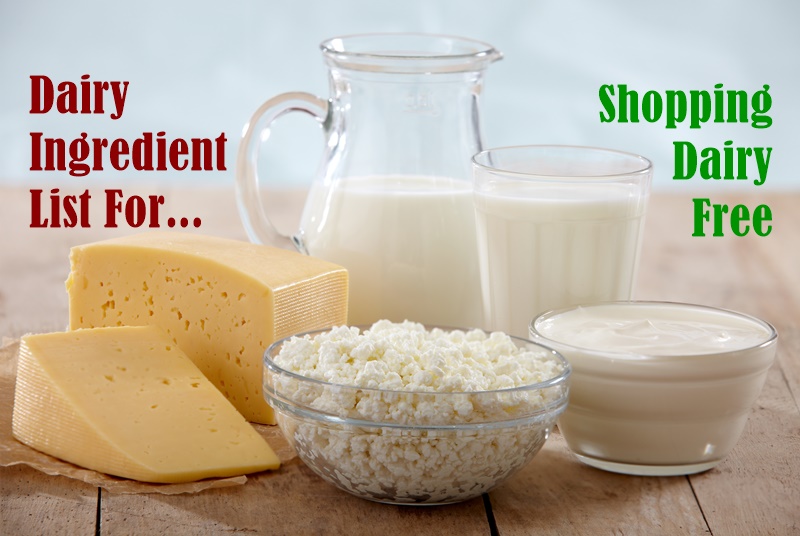
Here it is – Our handy guide to identifying milk ingredients on food labels, from the obvious to the downright obscure! The list below is from my book, Go Dairy Free: The Guide and Cookbook for Milk Allergies, Lactose Intolerance, and Casein-Free Living.
Please do not rely solely on this dairy ingredient list, as it is intended for informational purposes only. If you are dealing with a severe milk allergy or intolerance, always check with the manufacturer prior to consumption of any food product. Ingredients and processes are subject to change at anytime, which means a once “safe” product or ingredient may not be “safe” the next time around.
While many resources (such as FAAN) may note some of the ingredients that we have listed as “rarely dairy ingredients” as “safe” for milk allergies, we have opted to err on the overly-cautious side with this dairy ingredient list, because the potential for extremely sensitive milk allergies and intolerances seems to be increasing in frequency and the globalization of our food supply can create some unexpected ingredient issues.
Definitely Dairy Ingredients
- Acidophilus Milk
- Ammonium Caseinate
- Butter
- Butter Esters
- Butter Fat
- Butter Oil
- Butter Solids
- Buttermilk
- Buttermilk Powder
- Calcium Caseinate
- Casein
- Caseinate (in general)
- Cheese (All animal-based)
- Condensed Milk
- Cottage Cheese
- Cream
- Curds
- Delactosed Whey
- Demineralized Whey
- Dry Milk Powder
- Dry Milk Solids
- Evaporated Milk
- Ghee (see page 109 in Go Dairy Free)
- Goat Cheese
- Goat Milk
- Half & Half
- Hydrolyzed Casein
- Hydrolyzed Milk Protein
- Iron Caseinate
- Lactalbumin
- Lactoferrin
- Lactoglobulin
- Lactose
- Lactulose
- Low-Fat Milk
- Magnesium Caseinate
- Malted Milk
- Milk
- Milk Derivative
- Milk Fat
- Milk Powder
- Milk Protein
- Milk Solids
- Natural Butter Flavor
- Nonfat Milk
- Nougat
- Paneer
- Potassium Caseinate
- Recaldent
- Rennet Casein
- Sheep Milk
- Sheep Milk Cheese
- Skim Milk
- Sodium Caseinate
- Sour Cream
- Sour Milk Solids
- Sweetened Condensed Milk
- Sweet Whey
- Whey
- Whey Powder
- Whey Protein Concentrate
- Whey Protein Hydrolysate
- Whipped Cream
- Whipped Topping
- Whole Milk
- Yogurt
- Zinc Caseinate
Potentially Dairy Ingredients
- Artificial or Natural Flavors/Flavoring – These are vague ingredients, which may be derived from a dairy source. A few of particular concern are butter, coconut cream, and egg flavors.
- Cultured Dextrose – To make this food preservative, dextrose is fermented. Dextrose is a simple sugar that’s usually derived from corn. The bacteria used to culture, or ferment, the dextrose can be derived from dairy. But some manufacturers of cultured dextrose no longer use a dairy medium. If the bacteria used is derived from dairy, it would need to be clearly declared as “milk” on the label.
- Fat Replacers – Brands such as Dairy-Lo® and Simplesse® are made with milk protein.
- Galactose – This is often a lactose byproduct, but it can also be derived from sugar beets and other gums.
- High Protein or Protein – Ingredients noted with no further details may be derived from milk proteins (casein or whey). This is particularly true in “High Energy” foods.
- Hydrolyzed Vegetable Protein – The processing phase may use casein, but only trace amounts would likely remain.
- Lactic Acid Starter Culture – These cultures may be prepared by using milk as an initial growth medium.
- Lactobacillus – This term is noted often as a probiotic. It is in fact bacteria, not a food byproduct, and is named as such for its ability to convert lactose and other simple sugars to lactic acid. Though often utilized in milk products to create lactic acid, on its own, this ingredient is not always a concern. However, in some cases it may have been cultured or produced on dairy, and thus have the potential to contain trace amounts.
- Margarine – Milk proteins are in most brands, though not all.
- Nisin Preparation – This is a preservative that is often made using milk.
- Prebiotics – A newcomer on the digestive health scene, these are indigestible carbohydrates. They are quite different from probiotics, which are living microorganisms. Prebiotics, such as galacto-oligosaccharides, lactosucrose, lactulose and lactitol may be derived from milk-based foods.
- Tagatose – This alternative sweetener is often derived from the lactose in dairy products. It can, however, be derived from tropical date trees.
Rarely Dairy Ingredients
- Calcium or Sodium Stearoyl Lactylate – Stearoyl lactylates are derived from the combination of lactic acid (See any potential concerns with lactic acid below) and stearic acid. They are generally considered non-dairy and safe for the lactose intolerant and milk allergic (again, see below). However, the stearic acid may be animal derived, which could be a concern for vegans.
- Calcium, Sodium, or Potassium Lactate – Lactates are salts derived from the neutralization of lactic acid, and are rarely a dairy concern. For example, it was noted that the lactate found in one brand of orange juice was made from sugar cane.
- Caramel Color – Anything with caramel in its title may sound like a dairy red flag, but caramel color is typically derived from corn syrup and occasionally from potatoes, wheat, or other carbohydrate sources. While lactose is a permitted carbohydrate in the production of caramel color, it is rarely, if ever used.
- Lactic Acid – Lactic acid is created via the fermentation of sugars, and can be found in many dairy-free and/or vegan foods. Most commercially used lactic acid is fermented from carbohydrates, such as cornstarch, potatoes or molasses, and thus dairy-free. Though lactic acid can be fermented from lactose, its use is generally (I said generally; where concerned, always check with the manufacturer) restricted to dairy products, such as ice cream and cream cheese.
Surprisingly Dairy-Free Ingredients
- Calcium Propionate
- Calcium Carbonate
- Calcium Citrate
- Calcium Phosphate
- Cocoa Butter
- Cocoa Powder
- Coconut Butter
- Coconut Cream
- Cream of Coconut
- Cream of Tartar
- Creamed Honey
- Fruit Butter (Apple, Pumpkin, etc)
- Glucono Delta-Lactone
- Lecithin Oleoresin
- Malted Barley or other Grain-Based Malts
- Malt Liquor
- Malt Vinegar
- Milk Thistle
- Nut Butters (Peanut, Almond, etc.)
- Shea Butter
The above information and dairy ingredient list is copyright Go Dairy Free: The Guide and Cookbook for Milk Allergies, Lactose Intolerance, and Casein-Free Living by Alisa Marie Fleming . It was created for informational purposes only. Always use due diligence in consumption of manufactured foods where food allergies, sensitivities, or intolerances may be a concern.