
This post used to be called “understanding kosher,” but that’s a tall order. Kosher certification is a confusing web of symbols, standards, and even different spellings. It could take an entire book to cover the topic of kosher food production. But for the sake of dairy-free consumers, I have updated this quick guide to kosher symbols and certification. They can be a helpful tool for finding new dairy-free products, but it’s important to know what they mean and their limitations. The following information is based on the resources in my flagship book, Go Dairy Free: The Guide and Cookbook.
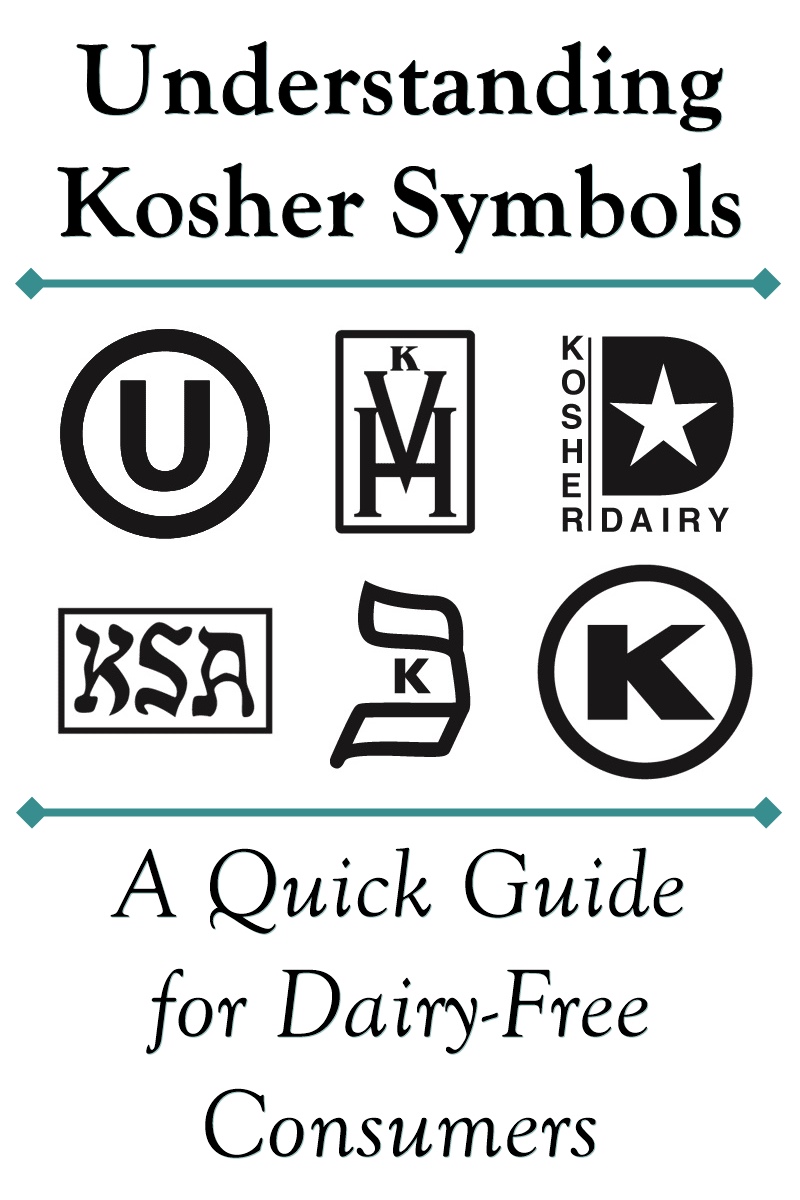
Kosher Symbols and Certification: What they Mean for Dairy-Free Consumers
Kosher certification is a very complex system of verification and labeling, which was originally created for spiritual purposes. But over the years it’s evolved into a helpful guide for many people who follow special diets.
When a product is kosher certified, all ingredients in the product and the process of the of producing the product must comply with strict kosher policies. There are two kosher dietary laws in particular that can help dairy-free consumers.
- Kosher pareve products must not contain milk, meat, nor any of their derivatives. In other words, kosher pareve products are dairy-free and meat-free, at least by ingredients.
- Meat and meat derivatives may never be mixed with milk or milk derivatives. Separate equipment for the preparation and storage of meat-based and dairy-based foods must be used. This means that kosher meat must be dairy free.
Products that are kosher certified will bear a kosher symbol, like the ones shown in the image above. A plain symbol is usually an indication that the product is certified kosher pareve. A symbol with the word “Pareve,” “Parev,” or “Parve” near it (yes, all spellings are used!), is confirmation of that certification. However, products with other lettering can also be dairy-free by ingredients. I have created a more detailed guide below.
Kosher Symbol Examples for Dairy-Free and Vegan Consumers
There are dozens of kosher certification agencies, each with their own symbol and specific processes. But they generally follow the same set of rules and labeling. The world’s largest kosher certification agency is the Orthodox Union, so I’ll use their symbols and guidelines as an example to explain the different types of relevant certifications.

 A plain “OU” symbol or “OU-Pareve” symbol indicates a kosher pareve product, which contains neither dairy nor meat nor any dairy or meat derivatives. It also verifies that the product was not made on equipment that is also used for making dairy products. (This is the OU’s standard; some other certifying agencies do not require dairy-free equipment. Also, please make sure you read the full post!) Vegetarians and vegans should take note that this does not guarantee the product is free of fish, eggs, or honey.
 An “OU-D” or “OU-Dairy” symbol indicates a kosher dairy product, which contains a dairy ingredient or a dairy derivative, or was made on equipment also used for making dairy products. So a kosher dairy certified product can be dairy-free by ingredients.
 An “OU-DE” symbol stands for “dairy equipment,” and means the product does not contain any ingredients with milk or milk derivatives, but it was made on dairy equipment.
 An “OU-M” symbol or an “OU-Glatt” symbol indicates that the product is Kosher meat. Since meat and dairy cannot be mixed under kosher dietary laws, kosher meat certified products must also be dairy free. However, these products aren’t suitable for vegans and vegetarians.
- An “OU-F” symbol indicates a Kosher product with fish ingredients. Fish is a tricky area. It’s considered pareve, and thus can be mixed with milk-containing ingredients.
- An “OU-P” symbol means kosher for passover. With the orthodox union certification, this also means kosher pareve. But some certifiers might certify products that are kosher for passover but not kosher pareve. In other words, a product with just a “P” on the kosher symbol, rather than “Pareve” spelled out, could contain dairy, depending on the certifying agency.
Quick FAQ on Kosher Symbols and Certification
Where will I see the kosher symbol? If a product is kosher certified, the symbol is often in small type on the bottom front of the package. But it can be printed in other places on the packaging.
Why is there a “DE” for dairy equipment if “D” can also mean dairy equipment? There doesn’t seem to be a cohesive answer to this. Logic would tell us that the DE emerged to separate dairy equipment products from ones that actually contain dairy. But most products without dairy ingredients that are made on dairy equipment still use “D” instead of “DE.”
Do you have a list of kosher symbols? There are dozens of kosher certification agencies worldwide. Fortunately, Kashrut.com has a quick list of Kosher Certification Agencies with sample symbols and contact information.
If a product is pareve, does that mean it was not made on dairy-free equipment? Not necessarily. It does mean the product is made without any dairy or dairy derivatives, but the strictness of a pareve designation can vary between certifiers and even among rabbis. Usually, if dairy equipment is used, it must have an approved cleaning process to achieve pareve status. That said, many certified kosher pareve products are made on dedicated dairy-free equipment.
Why do some pareve products have “may contain” statements for milk? A company might still choose to use a “may contain” statement for milk if they believe there is a possibility that traces of milk could still get into the product at some stage in productions. See our “May Contain” Guide to understand this voluntary labeling better. I’ve also included an explanation from the Orthodox Union in the next section.
Kosher Pareve is a Tool, not a Solution
Kosher labeling can be a very useful tool for most people who choose to cut dairy from their diet. But according to the Orthodox Union, the leader in kosher certification standards, individuals with a severe milk allergy should not rely completely on Kosher certification when selecting foods. They provided the following explanation.
The trace nuts and dairy disclaimer that is now printed on many products is there to warn consumers that although there are no nuts or dairy in the ingredients of the product itself, there is a possibility of parts per millions floating in the air and ‘contaminating’ the product.
The ‘contamination’ would only affect consumers with extremely severe allergies who can detect even the most trace amounts of the substance that they are reacting to. A product that is labeled OU (and thereby certified kosher parve) is halachically (by Jewish Law) parve. The parts per million does not affect the status of a product, because parts per million are negligible and have no halachic significance.
As an example, a factory might produce dairy and parve products on two separate production lines. Nonetheless, air-born particles of milk or whey powder might float onto the parve production line. Though a person might suffer an allergic reaction, the product is still halachically parve.
Companies have been especially cautious in the past few years to publicize this information as the public’s knowledge of allergens has grown.
If you are dealing with a severe milk allergy or high sensitivity, then you must always contact the company to discuss their processes. Food labels should never replace your own due diligence. You are the only one who can decide if a food is safe for your needs.
For More Dairy-Free Living Guidance, Get Go Dairy Free


20 Comments
Pingback: My/Mo Dairy-Free Mochi Cashew Cream Frozen Dessert (Review)
Pingback: Hälsa Oatgurt Blends Dairy-Free Nutrition and Pure Scandinavian Tradition
Pingback: Munk Pack Protein Cookies (Review): Vegan Gluten-Free Treats
Pingback: Jolly Llama Makes No Drama Dairy-Free Cream and Sorbet Pops
Pingback: Nature's Path Sunrise Chewy Granola Bars (Dairy-Free Review)
Pingback: Late July Organic Crackers & Cracker Sandwiches (Dairy-Free Review)
Pingback: Silk AlmondMilk Yogurt Review: This is More Than a Dairy Alternative
Pingback: Cascadian Farm Organic Chewy Granola Bars (Dairy-Free Review)
Pingback: Haagen Dazs Non-Dairy Ice Cream (Review): Tasting Notes & Full Info
Pingback: Halo Top Dairy-Free Frozen Dessert: Now in 14 Creamy Flavors!
Pingback: Trader Joe's Cookie Dough Review (Dairy-Free Versions)
Pingback: Trader Joe's Caramel Popcorn is a Sweet Vegan, Gluten-Free Treat
Pingback: Trader Joe's Baking Mixes Review including Seasonal Flavors
Pingback: Trader Joe's Coconut Whipped Topping (Non-Dairy & Vegan Review)
Pingback: Nii Premium Organic Nutrition Bar Review: Vegan, Certified Gluten-Free
Pingback: Shabtai Gourmet Cakes: Gluten Free Layers, Loaves and Rolls - Go Dairy Free
Pingback: Theo Peanut Butter Cups: Vegan Versions (Review)
Pingback: Love Grown Kids Cereals: Made with Beans! (Review)
Pingback: Allergy-Friendly Valentine's Day Treats - Plate It Safe
Pingback: Kosher AND Vegan: Double Trouble or Easy Peasy? | GirlieGirl Army